
We are working to combine our land tax policy with our monetary reform policy in a new way

During the holiday season I have been talking on email and skype and phone to various people round the world and in New Zealand. One of our challenges will be to get sufficient government revenue and introducing an adequate level of land taxes is a political challenge of immense proportions. Many are implacably opposed to land taxes, although they see the importance of the type of monetary reform we propose on this site.

It seemed to me always that those involved in the Georgist movement for land value taxes have thought they had all the answers, while those involved in monetary reform thought they had all the answers. It was in 1996 that I visited the New Economics Foundation in London and had started to understand the money issue, and during that time also spent time at the Henry George Foundation or whatever it is called in London. A few years later I noticed that Margrit Kennedy, the author of Interest and Inflation Proof Money, also had the beliefs that the two reforms should come at the same time, otherwise there are problems.

I found in 2005 when I was writing my book, that the man involved with promotion of Land Value Taxes in NZ, believed there was nothing wrong with the money system and any reform to it would be terribly damaging. So I couldn’t communicate with him. I was also aware that promoting an adequate land tax would be fraught with political trouble, so I was motivated to find fellow travellers internationally and see if they had any solutions or suggestions. Land tax has to have exemptions and there are anomalies, opposition. Scottish Greens have got it through, but only as far as local authorities And what is the use of a land tax at a local authority level when a local authority can’t remove income tax or GST?

In my search for these potential colleagues I discovered that the LibDems in UK had a subgroup called ALTER and Chairman Dr Tony Vickers had written an excellent paper on the political strategies needed to introduce land value taxes (LVT). I emailed him and he replied to me, copying in his executive in the process. So it was wonderful to discover Robin Smith in London and his colleague Adrian Wrigley in Brittany and talk with them about their proposal for what they call a Location Value Covenant.

I was also alerted just before Christmas to an email to many leading figures in the international Georgist movement. It suggested there was heresy in the ranks and people should stick to the Georgist dogma, (yes it used the words heresy and dogma.) This flushed out more people, from US particularly and from the Occupy movement who were convinced on both issues so I started an ongoing skype chat (no audio, but easier to work with than emails) with those people. We paused for breath every now and then while we had one-to-one skype chats or small audio groups as we came to understand what they were talking about.

I can’t pretend we have completely arrived at a solution, because we are still in the process of collaborating on a document with the new proposal and what it can do. But I can say it is looking at private debt, at mortgages, because it is mortgages where the two issues intersect. I can also say I am very excited and there are others round the world who are equally keyed up. It is taking a bit of time to get this to a stage where the proposal is easily understood and clear and feasible. So please be patient, and if you want to talk about it, do give me a call. (Skype callers please post a message first!)

 

Maori Party must be naive to negotiate for a committee on poverty

Set up a committee on poverty and say that is a way to stop it? Daft as. Hone is right. Koretake! Useless!

The way to stop poverty is to legislate and tax so that it stops the profiting from the passive ownership of land, resources or money. This is the New Economics Party policy and gets to the root of poverty issues. Tax what you use not what you earn, tax what you take not what you make.

Today I found that after the Global Financial Crisis in UK, there was a conference on Economic Justice and a Council of Economic Justice was set up. To the conference were invited many organisations which advocated monetary reform and many who advocated Land Taxation Tax and other resource taxes. This Council will have a great deal in common with our party. Meanwhile the Libdems have a group called ALTER which advocates land value taxes and the Scottish Greens now has a policy on this at local level. We are in touch with Earthsharing Canada and it is very gratifying to know that Frank De Jong is starting to read on the topic of monetary reform.

So oh dear Pita and Tariana. You are more naive than I thought. All you will do is watch the gap between rich and poor widen and widen, but you will at least know that statistics. To have a committee chaired by the very person who introduced a rise in the regressive GST tax regime shows how utterly ineffective it is going to be.

Monetary reform and land value taxes have been around for centuries, but in my lifetime they have never been implemented except for a brief period when we had unimproved value as a basis for  most of our local body rates.

As Europe counts down to Friday, global temperatures set to rise further and further

Today we heard the greenhouse gas emissions had risen by 5.9% in 2010. The world is on track for an 11 degree F rise in temperature and this came from the normally conservative Fatih Birol of the International Energy Agency. He had quite recently stated “We need to leave oil before it leaves us.” Something will have to happen quickly or else it will become completely irreversible.

Meanwhile our Treasury has of course stated that it has to revise the preelection forecast for economic growth, which, as I pointed out before, was predicated on three inaccurate assumptions. As I was gardening today I wondered how they managed to get it SO WRONG. Anyone with a brain who was following the developments in the Eurogeddon crisis could see there would be no smooth resolution of the debt crisis there. You can’t solve debt with more debt, it just puts off the day of reckoning.  And they assumed the price of West Texas oil would not go beyond $93 a barrel by 2016. Well I looked at the trend of that and it has already been beyond $93 but has dropped back. It is the lowest of the three types of oil quoted in our paper every day. On 2 Dec it was $100 a barrel and Dubai, which is the oil we rely on, was $106. As for growth of our trading partners, forget it. I don’t know why we pay these Treasury officials so highly if they are so stupid.

This week five people from Transition Town Lower Hutt put out a warning on the Euro crisis and suggested planning for a crisis by having a store of food, money and water. Sensible people all of them. Robin Westenra does a wonderful blog.

But good news. Today we heard from two people in Nelson who want to start our first branch there so we put them in touch with each other! And some really good people have now joined including a well respected environmental economist.

I received a letter back from the Minister of Defence last Friday saying no they had not received any information on the security implications if ur oil supply is disrupted.  He referred me to the Defence White Paper 2010  on www.defence.govt.nz. I haven’t had time to read it all, but once again I despair if our Minister of Defence and his officials don’t read the military reports put out in Germany and in US on the implications of oil supply for defence. Maybe there is a frustrated official somewhere in the Ministry of Defence. A job for someone?

So we await the Merkosy solution to the Europe debt issue


News from the New Economics Party

Well the election is over and we can start planning seriously for the next few years as we develop as a party. And we watch anxiously as Europe goes through so continual financial crises.

We have had our first skype call among those who were involved from the start and now have to plan to build our membership to 500 so we can register. We are also working on a form to register properly for the party and where people can donate money. And our IT team is connecting us to Facebook and Twitter and everything. Everyone who joins the website is sent an email and we are learning about the range of people that this attracts – ex Greens, climate change activists, peak oil transitioners, tweeters, bloggers, Max Keiser fans, students of human evolution and consciousness, Georgists, monetary reformers, thinkers, businesspeople who care for the earth. We have an enthusiastic fan from Greece and ongoing encouragement from some in USA.

Frank de Jong, the leader of the Greens in Ontario for 16 years, and now president of Earthsharing Canada has made contact and sent us his calculations on how they could raise $210 billion in resource rentals from oil, land value, Tobin Tax, other resource rents, infrastructure access and Pigouvian taxes to equal the revenue they currently raise from income tax, corporate tax, GST and other sources.. (Yes there was an economist called Pigou) It makes sense not to tax work. Ridiculous. But those who take from the commonwealth must contribute to the common good in equal measure. And we would add excise taxes from tobacco and alcohol as before and have a tariff for climate change too.

Frank’s calculations raise rent from oil, tar sands, natural gas, land, trees, fish, minerals, EM spectrum, internet, stock markets, patents, quotas, licences, and the Pigouvian taxes include roads, parking, docks, towers, wires, landfills and water.

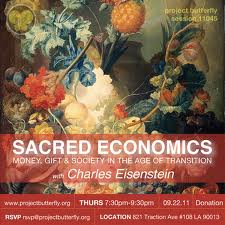
Today I was reading Sacred Economics by Charles Eisenstein, a brilliant 2011 book available from Living Economies. He sees resource taxes as internalising the true cost of production so that the public doesn’t pay the cost while the business reaps the profits. “I use the water, irrigate my dairy farm, keep the income and the public pays the cost of depleted aquifers and polluted rivers” would be our equivalent. He says as long as we think of ourselves as separate from others and from  Earth we will have this view that I keep the income and someone else pays. “But from the perspective of the connected self, connected to other people and to the earth, your well-being is inseparable from my own because you and I are not fundamentally separate”. His online course at http://evolverintensives.com/upcoming/ce-sacred-economics.html starts tomorrow!

Laurence is working on the Living Economies sector (April 12-13) of the Australasian Permaculture Convergence being held in Turangi next year (April 11-15) and the New Economics Party will be among those participating. He is also working to find a place where our party members can all stay together, and have our session on Friday 15 April.

Asset Sales or River Sales?

Asset sales are really river sales

25 November 2011

If asset sales go ahead then we will lose control over our big rivers, according to Laurence Boomert, Wellington Central candidate for the New Economics Party.

“Not only is it bordering on treason to sell our precious assets, but there are rivers like the Waikato and the Waitaki involved too.

“There is a link between asset sales of our major generation companies and the risk of associated loss of public control of our rivers with that transaction. These are our sacred rivers, our taonga and are the source of much life. They are not a commodity to be bought and sold.”
“These publicly-owned energy companies have a very big influence on our hydro river catchments. On the Waitaki River, for example, Mighty River Power has legal claim over waters, they own big tracts of land, can have interests in irrigation supply networks and can secure “requiring authority” to purchase land that they need for their schemes.”  Selling 49% of Meridian means selling 49% of the Waitaki River. We don’t want the water to be sold.

“We don’t think that the majority of New Zealanders have made these crucial connections and therefore risk making under-informed decisions on Saturday’s election.”

For further comment phone Laurence Boomert 027 258 8807

Financial Transaction tax needed to stop obscene bank profits

Financial Transaction tax needed to stop obscene bank profits

 24 November 2011

“The ridiculously high profits announced by ANZ shows we are overdue in imposing a financial transaction tax”, according to Laurence Boomert, New Economics Party candidate for Wellington Central.

ANZ announced record profits recently despite difficult economic conditions.

“Every bank these days deals in derivatives and these trades are high volume and fast turnover. A small financial transaction tax should be imposed on every transaction,” said Boomert.

“ANZ’s website shows exotic financial instruments like spot minors and forward majors but few people understands their complications”, said Boomert.  “Banks are gamblers these days not innocent intermediaries between lender and borrower, especially since the removal of the firewalls that protected the savings and loans sides of their business from their rampant speculations.”

The Pacific Financial Derivatives page on Facebook tells you that retail Forex accounts can now be opened with a large or small deposit and leverage of 1 to 100 is allowed in most cases. “If this isn’t gambling then I don’t know what is”, said Boomert.

“The problem is that as banks indulge in reckless speculation and suck out their undeserved profits the real economy of production and labour is endangered”

For further comment phone Laurence Boomert 027 258 8807 E: laurenceboomert@xtra.co.nz